
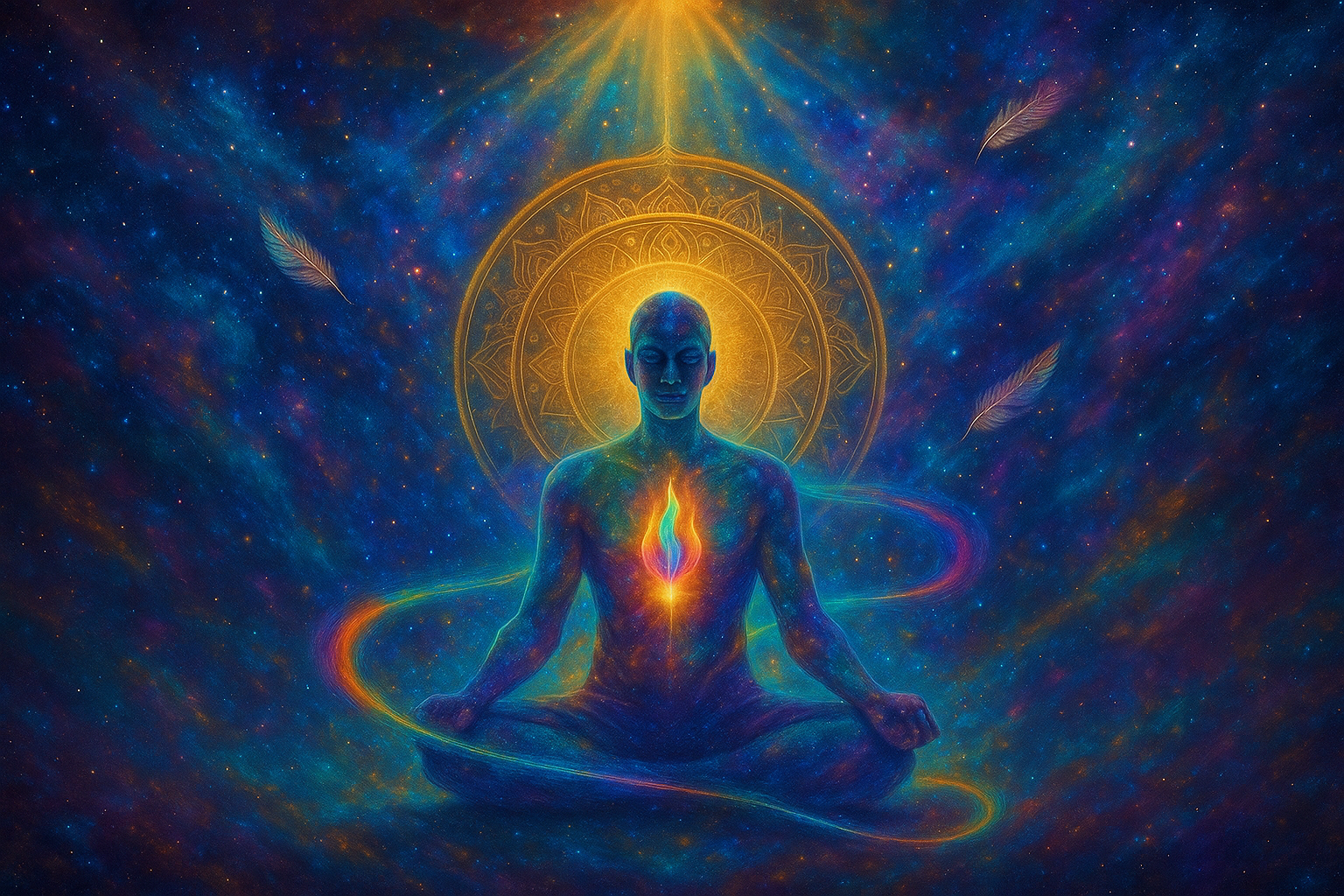
The Importance of Sadhana: Building the Life Your Soul Has Been Asking For

There comes a moment on the path when you realize that inspiration is not enough, insights are not enough, ceremonies are not enough, and breakthroughs—by themselves—are never enough. There must be structure. There must be rhythm. And there must be a daily returning to the inner altar where you meet yourself, your Source, and the truth of why you are here.
This is the essence of Sadhana.
Sadhana simply means “daily spiritual practice,” but the lived reality of it is far deeper. It is the foundation of all spiritual endeavor. It is the backbone of self-regulation. It is the crucible where your old patterns melt and your new ways of being crystallize. Sadhana is the place where your excuses weaken, your clarity grows, and your soul finally gets the space to breathe.
Sadhana is your personal, intimate effort to purify your consciousness so you can relate to the infinity within you. You can do it alone or with others, but the power of it will always be measured by your consistency. Create a regular Sadhana and suddenly you’re no longer drifting through life—you’re steering it. Deepen your Sadhana and the doors of direct experience open effortlessly, revealing a world inside you that was always waiting.
In traditions across time, there is a recognition of stages—cycles in which a new pattern becomes stable within your consciousness. These timeframes aren’t superstition; they’re somatic, neurological, and energetic truths.
After about 40 days, a negative habit begins to weaken. The mental loops that keep you small lose momentum, and your body’s chemistry shifts toward healing and prevention.
After 90 days, a new habit forms at a deeper level. Your subconscious—usually shaped by family, culture, and trauma—starts aligning with your conscious intention.
By 120 days, the transformation begins to take root as a permanent part of you. You’re no longer forcing change; it has become your natural way of being, influencing you physically, emotionally, psychically, energetically, and spiritually.
And if you carry a practice for 1,000 days, the wisdom becomes yours forever. You master it. You can access it under pressure, in crisis, in joy, in service. Worry becomes an artifact of imagination, not a lived reality. Synchronicities multiply. Life reveals itself as a coordinated miracle.
Yogi Bhajan said it plainly: “When we do Sadhana, what do we do? We challenge the weakness, the laziness, and our self-destruction. We challenge everything which is going to destroy us tomorrow.”
And Tony Robbins echoed a universal truth: “It’s not what we do once in a while that shapes our lives—it’s what we do consistently.”
We don’t win this path by force. We win through rhythm.
One of the misconceptions about meditation is that the method is what matters. It isn’t. You can meditate through breath, mantra, silent awareness, chant, stillness, or body. What matters is repetition and duration. Every time you sit, something reorganizes. Something unwinds. Something opens.
Three minutes of meditation shifts the blood and the chemistry of your body.
Eleven minutes influences the pituitary gland and begins rewiring your nervous system.
Twenty-two minutes unifies the negative, positive, and neutral minds, creating real mental integration.
Thirty-one minutes affects the whole mind and aura, balancing the 31 tattwas—the fundamental aspects of reality.
At 37.5 minutes, your aura begins reflecting to infinity, opening the doorway to inner sound and subtle perception.
At 62 minutes, your shadow and your positive projection integrate.
And at two hours and thirty minutes, the entire cycle of prana completes, anchoring the shift in your subconscious so it holds throughout the day.
You don’t need to start there. You can begin with an hour a day—only one twenty-fourth of your daily life. You could break it into parts: twenty minutes of breathwork, ten minutes of journaling to clear your mind, and thirty minutes of meditation, contemplation, or concentration. Or you could give the full hour to a single practice. What matters is not the configuration—it is the consistency and the devotion behind it.
Meditation is the art of deconstruction. You select a single focal point—breath, mantra, silence—and allow everything else to dissolve. Contemplation is the art of turning meditative awareness toward a specific question, feeling, symbol, or intention. It constructs new pathways. And concentration is the bridge between them, using an object—like a flame, an image, a photo—to train the mind to stay in one place, breaking the cycles of distraction and fragmentation.
Together, these practices retrain the nervous system, regulate emotion, and dismantle outdated patterns. They return you to the world with clarity, power, and grace. They make joy possible. They make peace sustainable. They make you trustworthy to yourself.
Because the truth is simple:
You cannot bypass sensation, but you can become so curious about it that it reveals wisdom instead of fear.
When your awareness meets your experience without resistance, sanity emerges. Peace strengthens. And life—past, present, and future—begins to reorganize around your grounded presence.
This is Sadhana.
A daily meeting with yourself, your soul, your Source.
A commitment to stop abandoning who you are becoming.
A choice to show up to your life rather than react to it.
A devotion to the light inside you that never leaves.
May every Celebrant reading this feel the invitation to begin—or deepen—their Sadhana now.
Not tomorrow.
Not someday.
Now.
Because the life you want is already waiting on the other side of your consistency.